|
Briefing One
|
13°C · Light Drizzle
|
|
|
London · Monday, 11 May 2026
|
FTSE 100
10,764.69
-0.70% |
£/$
1.3314 |
Tube
2 alerts |
|
|
|
|
|
Good morning, London. A property developer is now quietly purchasing the train timetable, and the high street is bracing for another collapse.
|
|
A massive retreat by the Duke of Westminster, a political earthquake in the outer boroughs, and the brutal efficiency of the artificial intelligence founder.
|

The daily commute as a private amenity
|
|
The timetable buyout
|
|
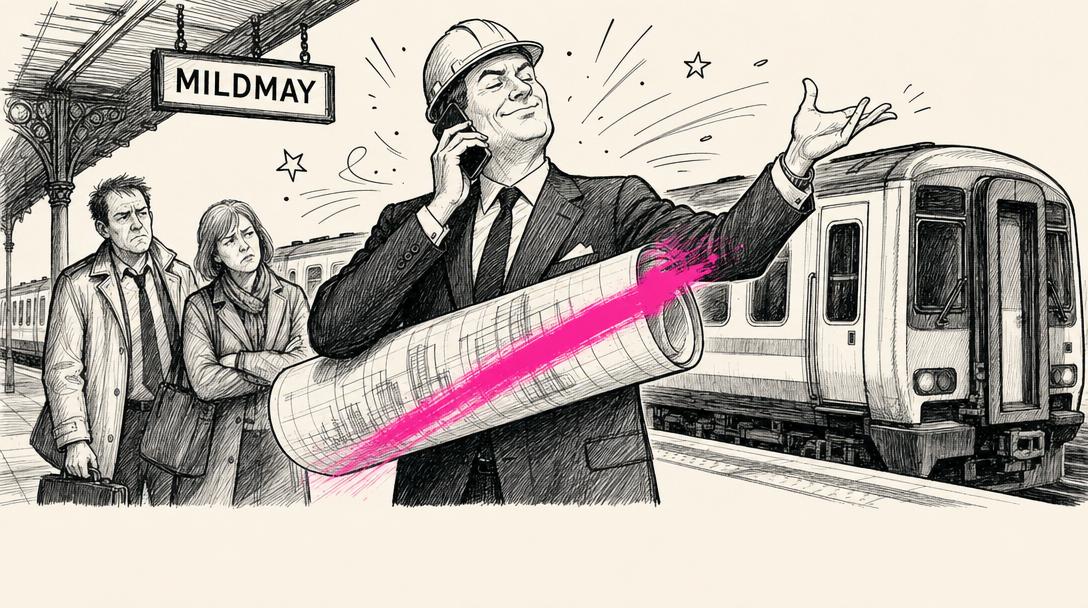
Public transport capacity is now a private commodity. The developers behind the £1.3bn Olympia regeneration have signed a five-year agreement with Transport for London to fund 16 additional peak-time shuttle services on the Overground's Mildmay Line. The trains run between Clapham Junction and Shepherd's Bush starting next week. The state cannot afford to lay the tracks or run the trains required to support major urban regeneration, so private capital simply buys the timetable. The developers need the footfall to justify their commercial rents, leaving the public network increasingly underwritten by the corporate masterplan. Further east, Greenwich Council is reviewing plans for a massive 132-bus depot in Thamesmead to support the shift to electric fleets. The transport grid is expanding, but only where the capital dictates it.
|
|
|
|
The Duke retreats
|
|
The oldest real estate dynasties are liquidating their physical exposure. The Grosvenor Group is planning to sell off £700m of its direct property holdings in the United States.
|
|
Led by the Duke of Westminster, the firm is shifting away from owning the concrete itself. They prefer indirect investments and joint ventures. When the landlords who own half of Mayfair decide that holding direct commercial real estate is too volatile, the market pays attention. Institutional capital is tired of the friction of physical buildings.
|
|
Quick take
Should property developers be allowed to buy public transport capacity?
Tap an option to vote
Vote to see yesterday's results →
|
|
|
The physical friction
|
|
Retail group TG Jones is facing potential administration by July unless lenders approve a rescue deal. The former high street arm of WH Smith is seeking a £35m injection and the closure of up to 150 stores.
|
|
Simultaneously, the residential market is tearing itself apart. The final days before the new Renters' Rights Act banned no-fault evictions saw a massive spike in Section 21 notices. Landlords rushed to clear their properties before the regulatory window closed. The physical economy is a zero-sum game of rising costs and legislative traps. The retailers cannot afford the leases, and the landlords are fleeing the regulation.
|
|
Zoë Garbett, Hackney
|
|
Zoë Garbett is the newly elected Green Party Mayor of Hackney. Down the road, Liam Shrivastava took the mayoralty in Lewisham. The traditional two-party monopoly over the inner-city boroughs has officially fractured. The assumption that London votes as a unified progressive bloc under Labour is dead.
|
|
Dmytro Dubilet, Central London
|
|
The co-founder of London-based Fintech Farm has just proven how cheap software has become. He used an artificial intelligence coding agent to build a complex internal operations platform for his company. The project cost roughly $15,000 in token usage. Building the same system traditionally would have required fifty engineers and up to $2m. The barriers to enterprise scale have completely evaporated.
|
|
|
| "No, cancel the 8:15 to Clapham. It doesn't align with our retail strategy." |
| Share |
|
|
Cetin Kaygusuz, Harrow
|
|
The owner of Melissa Restaurant on Station Road has been shortlisted for Chef of the Year at the Turkish Restaurant and Takeaway Awards. The venue itself is up for Best Turkish Restaurant in North and West London. Consistent, highly competent independent dining in Zone 5 quietly outlasts the heavily funded concepts in Soho.
|
|
The state pays up
|
|
The Department for Business and Trade has committed to paying all staff and contractors the London Living Wage of £14.80 an hour — finally meeting the baseline the state demands of others.
|
|
The move coincides with the 25th anniversary of the grassroots campaign that started in East London. It is a sharp irony that the central department responsible for regulating corporate growth and employment standards had to be actively lobbied to pay a survivable wage in the capital it operates from.
|
|
The Finsbury Park crown
|
|
The Plimsoll has been named London's 'Gastropub of the Year' in the inaugural OpenTable Restaurant Awards. Run by chef duo Ed McIlroy and Jamie Allan, the St Thomas's Road venue built its reputation on a flawless Dexter cheeseburger and an absolute refusal to compromise on pub atmosphere. It is the definitive model for modern London hospitality. Take a decaying local pub, install an elite kitchen, and change absolutely nothing about the woodwork.
|
|
Four things to do tonight
|
|
The Canadian alternative country band Cowboy Junkies play the London Palladium tonight. A sharp, atmospheric start to the week in the West End. Doors at 6:30pm.
|
|
Comedian Kiran Deol begins a week-long run of her show 'Assault On Comedy' at the Soho Theatre this evening. She dissects her own experience of surviving a violent attack and fighting the American legal system. Unflinching and highly recommended.
|
|
The Bill Murray comedy club in Islington is hosting two consecutive work-in-progress hours from Maia Tassalini and Grace Campbell. Essential viewing for anyone interested in how stand-up material is actually forged. Starts at 6:30pm.
|
|
Author Sable Sorensen is in conversation with Katherine Webber at Conway Hall in Holborn at 7:30pm. A dense, literary dissection of contemporary fiction inside one of the capital's finest historic lecture spaces.
|
|
Worth twenty minutes
|
|
The Fairy Tales exhibition at the British Library is an excellent mid-week detour. It strips away the sanitized modern retellings to focus on the dark, original manuscripts and early European folklore.
|
|
Thoughts
|
|
Look at who is actually paying to run this city today. The developers behind the Olympia regeneration are literally purchasing the train timetable, funding extra Overground services because Transport for London cannot afford the capacity they need. Meanwhile, the Department for Business and Trade had to be aggressively lobbied just to pay its own contractors the London Living Wage. The civic infrastructure is stalling, and private capital is quietly buying the gaps.
|
|
This is a profound shift in how London functions. The historical assumption was that the state built the grid and the market built on top of it. Now, the developers are funding the trains, while the oldest landlords — like the Duke of Westminster's Grosvenor Group — are retreating from physical property entirely. The state is stepping back into a purely regulatory role, passing renters' rights and debating employment laws, while the private sector is left to actually move the people. The city is being privatised by default, not by ideology, simply because the public purse is empty.
|
|
The week is moving. Hit the ground running.
|
|
Thoughts on the privatised Overground? Hit reply. We read every one.
|
|
Forward this to someone who'd get it.
|
|
Until tomorrow, London.
|
|
|
|
Briefing One — A daily London briefing
You're receiving this because you subscribed at briefingone.com
Unsubscribe ·
View in browser ·
FAQ
|